Luck rules a few bets, probability rules many
A fair coin that pays 1.1 times your bet on heads has a real edge: ₹1,000 bet on it should make ₹50. Bet it as 10 bets and you end with a gain of about ₹50 only a quarter of the time; as 1,000 bets, 86% of the time. Part 1 of The maths behind rule-based trading and investing.
The maths behind rule-based trading and investing · Part 1
Every rule-based strategy is a bet with a small edge, repeated many times. Before looking at markets, it helps to see what a small edge does on its own, with the simplest bet there is: a coin.
Take a fair coin. Heads, you win 1.1 times your bet. Tails, you lose your bet. You win only half the flips, but the extra 10% on every win gives you a real edge: on average you make 5 paise for every rupee you bet.
So ₹1,000 bet on this coin should make ₹50. Now bet that ₹1,000 in three different ways.
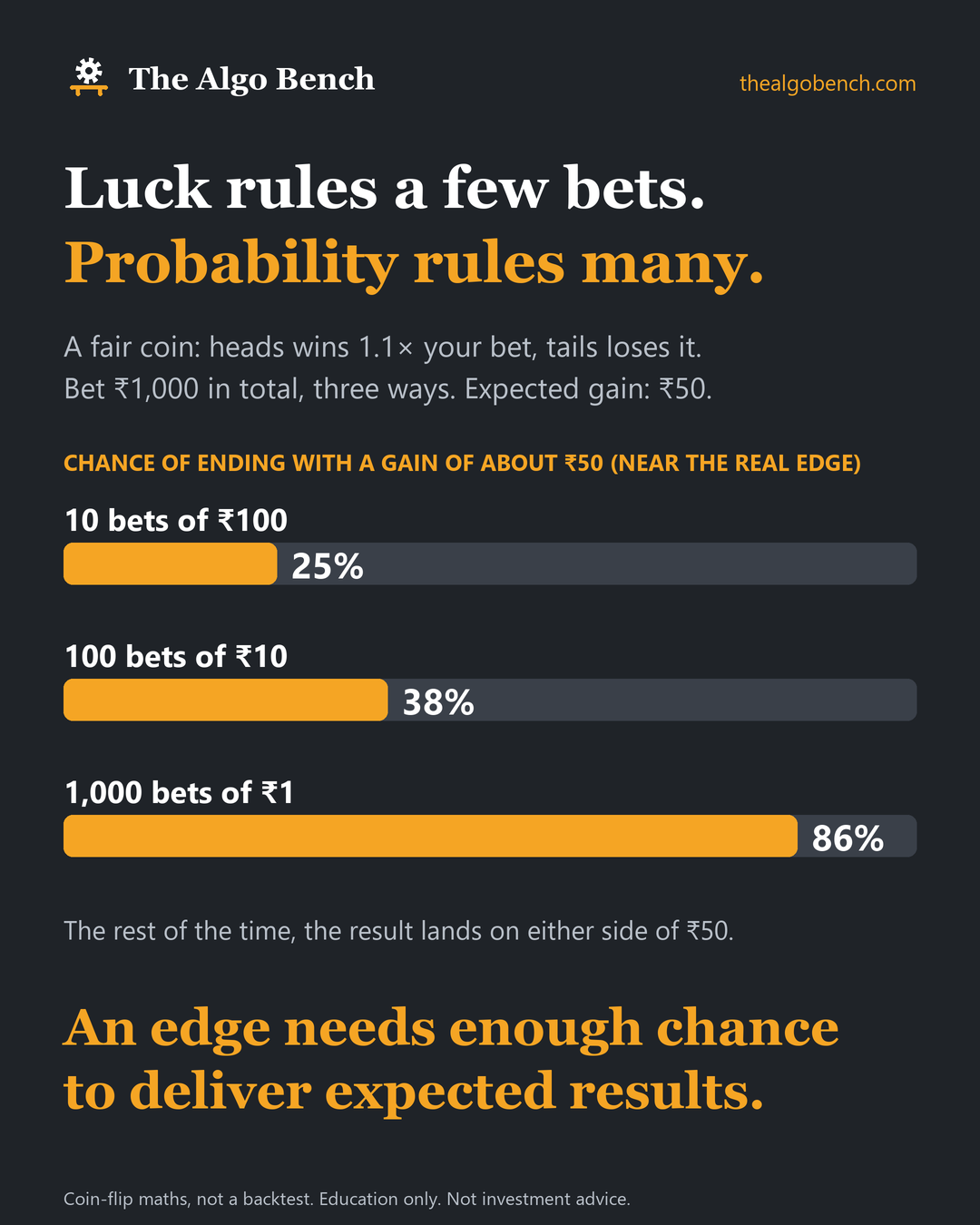
| How the ₹1,000 is bet | Lose money | Gain of about ₹50 (₹0 to ₹100) | Win more than ₹100 | Expected gain |
|---|---|---|---|---|
| 10 bets of ₹100 | 38% | 25% | 38% | ₹50 |
| 100 bets of ₹10 | 31% | 38% | 31% | ₹50 |
| 1,000 bets of ₹1 | 7% | 86% | 7% | ₹50 |
Same coin, same edge, same money, same ₹50 expected. The only thing that changed is how many bets the money was spread over.
- With 10 bets of ₹100, you end with a gain of about ₹50, the real edge, only one time in four. The rest of the time luck decides: you either lose (and 17% of the time lose ₹200 or more) or win well beyond the edge.
- With 1,000 bets of ₹1, you end with a gain of about ₹50 86% of the time.
What this means for a strategy
- Ten trades tell you almost nothing. With a small edge, ten trades are mostly luck in either direction. A strategy judged on its last ten trades is being judged on noise. This is why our eight checks ask for enough trades, and a t-stat of about 2, before calling anything an edge.
- Many small bets beat a few big ones. More bets don’t raise the expected profit. They make it much more likely that you actually collect it.
- Rules are what make large numbers possible. Nobody takes a thousand trades with the same discipline by hand. A rule set, carried out the same way every time, is what turns a small edge into a large number of identical bets.
An edge needs enough chance to deliver expected results.
But a year only has so many trades
One strategy on one market may give you a hundred trades a year, not a thousand. The next parts look at how to get more bets out of the same year, by flipping different coins (markets) in different ways (strategies), and at the catch that comes with it.
Planned so far in the series: win rate isn’t the score · losing streaks are normal · more coins, more ways to flip · the correlation trap · how big each bet should be.
Coin-flip probabilities are exact binomial results for a fair coin paying 1.1 times the bet on heads and losing the bet on tails, with ₹1,000 split into equal bets. “A gain of about ₹50” means a final result between ₹0 and ₹100. No market data and no costs. Real strategies have neither a fair coin nor fixed payoffs, so treat this as an illustration of how edges behave, not as a model of any strategy. Education only, not investment advice.
Was this useful?
More to say, or spotted a mistake? Write to [email protected]. We read everything.