Same strategy, three stock lists: ₹100 became 1,201, 3,057 or 15,505
We ran one momentum strategy three times and changed only the list of stocks it could buy. The usual shortcut made it look almost 13 times better than it really was.
We ran the same stock strategy three times: same rules, same costs, same 12½ years. Only the list of stocks it was allowed to buy changed.
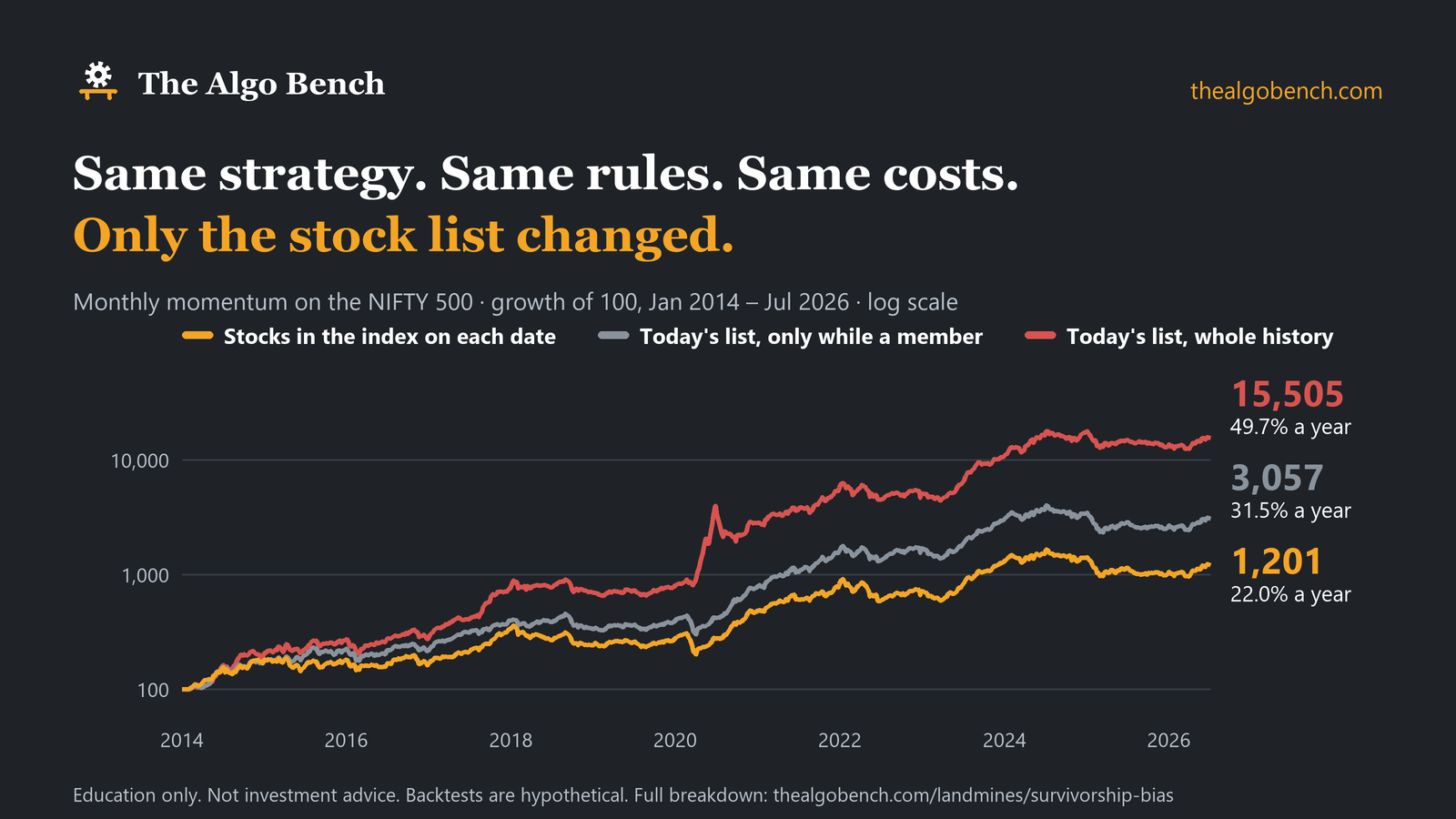
| Stock list | ₹100 became | A year |
|---|---|---|
| Stocks in the NIFTY 500 on each date (honest) | 1,201 | 22.0% |
| Today’s NIFTY 500 list, used only while each stock was a member | 3,057 | 31.5% |
| Today’s list applied to the whole history (the usual shortcut) | 15,505 | 49.7% |
The strategy is our monthly momentum rule: rank NIFTY 500 stocks by their 3- and 9-month returns, hold the top 15. Data: 1 January 2014 to 3 July 2026, 0.15% cost per side.
Why the gap
Today’s list quietly does two things:
- It deletes the failures. Every company that crashed, was delisted or shrank out of the index is missing, so the strategy can never buy one.
- It lets you buy tomorrow’s winners early. 264 of today’s 499 names were not in the index at the end of 2013. A backtest on today’s list buys them years before any real investor could have.
That is survivorship bias. If a stock backtest doesn’t say it used a point-in-time universe, read its returns as flattered, not as an estimate.
The full breakdown, with drawdowns and how the honest universe was rebuilt, is in the Landmine Survivorship bias.
Was this useful?
More to say, or spotted a mistake? Write to [email protected]. We read everything.